

Join us at the 36th Annual Los Angeles Vintage Paperback Show. We’ll be signing and selling the latest books from Cycatrix Press, Jason V Brock, and William F. Nolan.

Join us at the 36th Annual Los Angeles Vintage Paperback Show. We’ll be signing and selling the latest books from Cycatrix Press, Jason V Brock, and William F. Nolan.

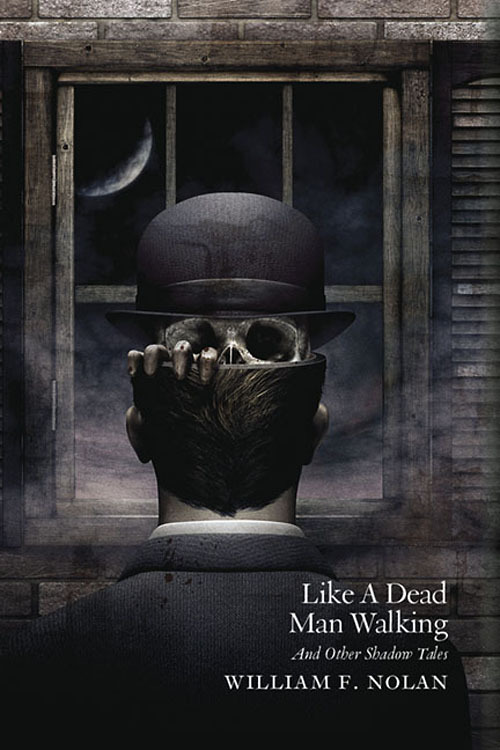
Like a Dead Man Walking, by William F. Nolan, Centipede Press, 2014. Cover art by David Ho, info and preview: centipedepress.com.
“Sherlock Holmes…Interdimensional demons…Aliens…Killers and child predators…Time travelers…Vampires…Even the end of the world, in more ways than one…All are contained within these pages. From the darkest corners of imagination to the precipice of human achievement, William F. Nolan delivers the goods in this assortment of recent works: his first all-new collection in his long and storied career. Working with editor Jason V Brock (Milton’s Children), Nolan brings to shocking life not only debauched murderers and depraved loners, but also fascinating portraits of personal reflection; the heroes of yore in poetry; pages from Nolan’s notebook; and an exclusive, intimate interview with his beloved friend, the late Richard Matheson (I Am Legend). Centipede Press is pleased and proud to offer this fantastic new assemblage of tales from an acknowledged master of the dark fantasy and science fiction genres, complete with insights into the stories, and a probing intrtoduction from editor Brock: This is not only Nolan’s most recent collection, but likely his very best. Come along for the ride and discover things that may (or may not) be Like a Dead Man Walking…You are sure to enjoy the journey. This signed limited edition is just 300 copies. The dustjacket is the work of David Ho. Each copy is signed by William F. Nolan, Jason V Brock, and David Ho.”
10:00 am |
Gennaio 26 2014
| 2 note


William F. Nolan is perhaps best known for coauthoring the novel Logan’s Run with George Clayton Johnson, and has written hundreds of pieces, from poetry to nonfiction to prose. He also had a long career in the movie industry, and co-wrote the screenplay for the 1976 horror film Burnt Offerings which starred Karen Black and Bette Davis. Nolan has also been a prolific editor of collections (by others), and anthologies, frequently with Jason V. Brock. He has received the Living Legend in Dark Fantasy award by the International Horror Guild in 2002. In 2010, he received the Lifetime Achievement Stoker award from the Horror Writers Association (HWA).
Jason V Brock is an American author, artist, editor and director. He is the CEO and co-founder (with his wife, Sunni) of JaSunni Productions, LLC, whose documentary films include the controversial Charles Beaumont: The Short Life of Twilight Zone’s Magic Man, andThe AckerMonster Chronicles. His novella, Milton’s Children, was published by Bad Moon Books in early 2013. He has partnered with William F. Nolan as co-editor on several anthologies. They most recently worked together on Tales from William F. Nolan’s Dark Universe comic book adaptation of Nolan short stories. (Available from Bluewater Productions).
DARK UNIVERSE is meant to showcase graphic adaptations of stories contained within the DARK UNIVERSE omnibus, a collection of short works by author Nolan. Plans are to adapt these stories into six individual issues and then later collect them all in a trade paperback or hardcover edition. (Note: A review of the first three issues was featured on this site in February 2013. An updated review will appear on this site shortly. )
Further insights regarding the production of Tales from William F. Nolan’s Dark Universe were obtained during a recent conversation with the authors:

Why adapt Dark Universe for comics? Why not an audio presentation, such as a CD? Or a movie or TV series? Even a stage play?
Jason V Brock: It’s a natural, really. I mean, Bill’s (Nolan) stories are visual and have a lot of visceral impact, so when we put the original deal together with Bluewater for Logan’s Run: Last Day and the subsequent Logan comics, we asked for a mini-series of the horror titles. Plus, once they come out as comics, then the plan is to collect them together in a graphic novel format with an introduction from the two of us. Should be quite a package—
William F. Nolan: Exactly. Darren (Darren G. Davis, publisher) at Bluewater was working on a Vincent Price series at one time as well, so it was a logical extension of that idea. I’ve always liked adaptations of my work into comics, which has happened on other occasions, so when we got this going, I asked to adapt half, and wanted Jason to adapt the rest. We did six stories apiece, so twelve total. They turned out well, I think…
Strangely enough, I did have an audio version of several of my stories done by an outfit in San Francisco. We recorded them with sound effects, actors, and full introductions read by me. It never materialized, unfortunately.
Brock: Yes, it’s too bad. I was with you during the recording of the intros. They were to be streaming on the web, then CDs later.
Nolan: Right. An anthology movie would never work, for the same reason an anthology TV show wouldn’t – no one seems interested in that format these days. Now a stage play is an interesting idea. I wrote one about Dashiell Hammett called Dash that’s been performed a few times.
Whose idea was it to do a comic book version of select stories?
Nolan: Mine, as I recall.
Brock: That’s correct.
How hard is it to adapt? Are certain stories selected because of ease of adaptation? Or, other criteria? Are there some stories that you would like to adapt to comics that aren’t possible because of content or difficulty to translate to a visual medium?
Brock: Adapting stories is harder in some ways, and, like film or TV adaptations, sometimes one has to alter the original story to achieve what the visual medium of comics requires—

Nolan: That’s right. People never understand that about movies or television. Sometimes you have to rewrite or rework things, combine elements, drop things, and so on. Doing a straight “literal” adaptation almost never works. The only exception I can think of is The Maltese Falcon. It was a near verbatim copy of the book, but that’s another story…
We each chose the stories we wanted to do; I adapted the stories of mine that I felt had the best characters (‘The Halloween Man’, ‘Major Prevue Here Tonite’, ‘Heart’s Blood’, ‘Ceremony’, ‘Starblood’, and ‘The Partnership’). They are some of my favorites in the collection (Nolan’s Stealth Press horror omnibus Dark Universe). Jason really did a great job, though! The stories he picked were very hard to adapt, I think. I know I couldn’t have done them! And he pulled it off beautifully, I might add.
Brock: Much appreciated. It was fun. As you say, I had to change a few things to make them work, but they came together well… My main criteria were I wanted to do something memorable, something that doesn’t normally get adapted. Plus, we wanted to avoid things that others had adapted previously, too.
(Brock adapted the following stories: ‘The Pool’, ‘Vympyre’, ‘Him, Her, Them’, ‘The Giant Man’, ‘Boyfren’, and ‘A Real Nice Guy’.)
Is there a new revised print edition of Dark Universe the anthology coming to market?
Brock: Actually, yes, that’s in the works. I am the editor on Bill’s upcoming new collection, which was originally to be published by Arkham House, but which fell through with their apparent dissolution. Too bad, as it would have been an interesting fit for them, and is pretty much completed. I was able to garner interest for it from the fantastic Centipede Press, however, and I believe it should be out in time for the World Fantasy Convention in Brighton, England later this year, which we will all be attending. It’s called Like a Dead Man Walking and Other Shadow Tales, and will feature about 90% new, unpublished material, with a few classic reprints to round it out. Later, Jerad (the publisher) is planning on a huge, current Best Of William F. Nolan that I convinced him was a good follow-up to this, and that will be, I believe, a part of his Masters of the Weird Tale series. It will have science fiction and horror, as well as some literary works and poetry.
How are the artists selected for the stories?
Brock: Darren G. Davis (the president of Bluewater) handles all of that—
Nolan: We do get some say over the type of art, but he does the artist selection, as Jason pointed out. I love the art in the Tales from William F. Nolan’s Dark Universe series, and really liked the art in most of the Logan series, especially the first four issues.
How much of the comic layout and panel art is determined before assigning to the artist?
Nolan: Well I write the scripts for the comics as a sort of screenplay format, with basic scene setting, character description and so on, but I use all the dialogue from the stories, and the plots. Jason works a little differently, I know…
Brock: True—I prefer to write very detailed scripts, and break down each scene into panels with a lot of specifics for the artist. I had to do that, as a few of the ones I adapted were quite short, and these had to carry over half of a twenty-two page comic. Of course, I use the setting, plot, and dialogue (mostly) from the stories…
How much does the artist contribute?
Brock: For me, not a tremendous amount in terms of characterization and paneling; in terms of artwork and the “look,” a great deal…
How easy or hard is it to translate these stories to an illustrated medium?
Nolan: I grew up on comics, and I used to write comics with my departed pal Charles Beaumont (The Twilight Zone), but they weren’t horror titles. I like adapting works into other mediums, so it’s fairly simple for me—
Brock: Well, it depends a great deal on the tale that you’re adapting, I think. Some are easy and others are more difficult.
Are there any benefits to a comics version of these stories? More impact? Able to tell a story in less pages because of the visual/text capabilities?
Brock: I think it’s a great way to introduce younger readers to new stories. The challenge was to expand rather than condense, as Bill has a spare writing style, so I really had to wring more from the story without resorting to a padded feel.
Nolan: I agree with Jason. Young people love the visual impact, so it gets them to read more, and if they like these, then maybe they’ll check out the books we do.
Compare this work to your work on the Logan’s Run comic. Was it easier or more difficult to adapt, Dark Universe or Logan’s Run?
Nolan: We didn’t actually adapt any of the Logan series—

Brock: That’s true, though I have done a one-shot based in that world called Logan’s Run: Solo. It’s an original piece, however, and not an adaptation. The story is about a very far-future Logan and what happens to him as an aged Runner. On Logan’s Run: Last Day we were consultants, and did the costume designs and plotting of the story over the first six issue arc, then Paul J. Salamoff wrote it.
Nolan: I have to say that I’ve read Logan’s Run: Solo and thought it was just fantastic. Ingenious what Jason did with the character and the scenario. It’s going to be an aspect of the upcoming book we’re planning to co-write in the Logan universe called Logan Falls, which will turn the franchise upside down—
Brock: Well, I hope it does… It will also incorporate, like Logan’s Run: Solo, the pieces from the Bluewater Logan’s Run: Last Day series called ‘Future History’, which I created but was not credited with. I’m reclaiming all of that back-story, as it was mine anyway, and both of us felt was one of the more interesting aspects of the series. It was a way of modernizing the older elements of the Logan saga; I want to deconstruct the “Logan mythos” and do more with the characters.
Would you like to work in comics again? On what sort of project? Do you have any plans to do so?
Nolan: Of course. I love comics!
Brock: Yes. I enjoy the medium a lot. We are doing a couple of things currently, but can’t discuss them yet.
What else are you presently working on?
Nolan: I’m always working on about eight or ten books at any one time… Jason mentioned a few of them. Hippocampus Press is doing a collection of my writings about Ray Bradbury which is due out very soon called Nolan on Bradbury; it’s edited by S. T. Joshi, and has pieces from Ray, Jason, S. T., and Greg Bear as well… And of course waiting on the Logan’s Run re-make!
Brock: Well, we just dropped our documentary on Forrest J Ackerman (The AckerMonster Chronicles!) to rave reviews, so Sunni (my wife and film editor) and I are promoting that. As I said, Bill, Sunni, and I will be at several cons throughout 2013, from World Fantasy to World Horror, to Norwescon, and OryCon… Then I just had my standalone novella, Milton’s Children, come out from Bad Moon Books. Hippocampus Press is also releasing my first short story collection, Simulacrum and Other Possible Realities soon, and I’m still working on NAMELESS which is a biannual digest… You can grab that in PDF and print format. The work doesn’t end!
NEXT: A REVIEW OF ALL ISSUES PUBLISHED TO DATE OF WILLIAM F. NOLAN’S TALES FROM THE DARK UNIVERSE.


Charles Beaumont (January 2, 1929 – February 21, 1967) was a prolific American author of speculative fiction, including short stories in the horror and science fiction subgenres. He is remembered as a writer of classic Twilight Zone episodes, such as “The Howling Man,” “Miniature,” and “Printer’s Devil,” but also penned the screenplays for several films, among them 7 Faces of Dr. Lao, The Intruder and The Masque of the Red Death. As best-selling novelist Dean R. Koontz has said, “[Charles Beaumont was] one of the seminal influences on writers of the fantastic and macabre.” Beaumont is also the subject of a documentary, Charles Beaumont: The Life of Twilight Zone’s Magic Man, by Jason V Brock.

Illness and death
When Beaumont was 34 and overwhelmed by numerous writing commitments, he began to suffer the effects of what has been called “a mysterious brain disease.” He began to age rapidly. His speech slowed and his ability to concentrate diminished.

“He was rarely well,” his friend and colleague William F. Nolan (who went on to co-write the science fiction novel Logan’s Run) would later recall. “He was almost always thin, and with a headache. He used Bromo-Seltzer like most people use water. He had a big Bromo bottle with him all the time.” Other symptoms were of the professional as well as physical persuasion, Nolan went on: “He could barely sell stories, much less write. He would go unshaven to meetings with producers, which would end in disaster. You’ve got to be able to think on your feet [as a script writer], which Chuck couldn’t do anymore; and so the producers would just go, ‘We’re sorry, Mr. Beaumont, but we don’t like the script.'”

Some (including friend and early agent Forrest J Ackerman) have asserted that Beaumont suffered simultaneously from Alzheimer’s and Pick’s diseases, but it has also been speculated that the condition was related to the spinal meningitis he suffered as a child. The former diagnosis was echoed by the UCLA Medical Staff, who subjected Beaumont to a battery of tests in the mid-1960s. As recalled by Nolan, the UCLA doctors sent Beaumont home with a death sentence: “There’s absolutely no treatment for this disease. It’s permanent and it’s terminal. He’ll probably live from six months to three years with it. He’ll decline and get to where he can’t stand up. He won’t feel any pain. In fact, he won’t even know this is happening.” Nolan himself sums up what happened: “Like his character ‘Walter Jameson,’ Chuck just dusted away.”

Several fellow writers, including Nolan and friend Jerry Sohl, began ghostwriting for Beaumont in his final years, so that he could meet his many writing obligations. Privately, he insisted on splitting these fees.

Charles Beaumont died in Woodland Hills, California at the age of 38. But at that time, said his son Christopher later, “he looked ninety-five and was, in fact, ninety-five by every calendar except the one on your watch.” Beaumont’s last residence was in nearby Valley Village, California. He left behind his devoted wife Helen, and two sons and two daughters. One son died in 2004 of eerily similar circumstances. The other, Christopher, is a successful writer in his own right.

Charles Beaumont is buried at San Fernando Mission Cemetery.



Good Wednesday,
The Lockbox is happy to have a guest today. You may remember Stephanie Wytovich. I interviewed her last summer. Well, she’s back, and she’s going to talk about her forthcoming book of horror poetry, HYSTERIA.
Without further ado, here she is.
-So…talk to us about HYSTERIA. What’s it about?
The easy answer is that HYSTERIA is about madness, but to me, it’s always been about acceptance. When I sat down and decided to start writing it, I essentially decided to go a little mad myself. There was nothing easy about writing this collection: no fun nights composing next to the moon, no clever evenings spent making up metaphors and bringing characters to life.
It was hard.
And it was painful.
I read a lot of abnormal psychology, studied the diseases of the brain, and traveled across the states to visit different asylums and feel the air and the charge of what it meant to be locked up in solitary. I sat in the isolation rooms of West Virginia’s State Penitentiary, and spent the night at the Trans-Allegheny Lunatic Asylum.
And then I met her.
Hysteria.
Most of the pieces came to me late at night, crazed and racked by insomnia, and when they did, they were fluent and clear, as if I were talking to the characters one-on-one. I wrote down their voices, shaped the faces that I saw in my nightmares, and looking back, it’s no wonder I didn’t sleep. The patients that readers will meet in this collection are vicious, cruel, and more often than not, completely insane.
Although there are a few innocents.
But who out there is really walking around with a clean conscience?
-What inspired you to put the book together?
When I was an undergraduate at Seton Hill University, I had to start a blog for my Intro. To Literary Study course. I heard everyone talking about blogs and their importance, but to me, it just seemed like another chore that I had to maintain when all I wanted to do was write poetry and study art. But, I created one…quite sarcastically at that.
“Join me in the madhouse,” I said.
Blogging drove me insane, and I hated doing it. And then one day, I hated it a little less, and then even lesser than that. The crazy part about it was that I soon started doing it for fun. I played with the madhouse theme, reviewing psychological films and critiquing books under the veil of psychoanalytic criticism. I read a lot of Freud—probably too much Freud—and paid special attention to his ideas on sexuality and the uncanny.
I saw madness—erotic, uncanny madness—everywhere I went.
The thick, black sludge of the mind’s breaking point.
And when I realized that madness broods inside us all—whether we choose to accept it or not—I knew that I had to explore it, dissect it, rip it apart with a scalpel and study it.
And so I did.
-Is there anything in there that shocked even you?
The entire collection was/is quite shocking to me. Yes, I realize that probably sounds odd considering I write horror, but I don’t think I’ve ever created something so dark, so angry before. There are pieces in there that I look at and think who/what wrote that?
But that’s what I wanted.
I wanted the voice that not only sits in the shadows, but is the shadows. I wanted darkness, blackness, and madness all wrapped up in a straightjacket and ready to go.
And then I wanted to release it and watch the asylum burn.
-Do you ever see yourself writing anything but horror?
Horror is what I do—what I love to do—and I can’t imagine doing anything else, because let’s face it… horror is in everything. What’s scarier than exploring space and meeting aliens? What’s more frightening than meeting creatures that exist only in your wildest dreams? And what’s more horrifying than falling in love?
Fear is in everything.
It doesn’t matter what genre I’m writing in.
I’m going to strangle it and take it down.
-Name a book/tv show/movie you like that would surprise people.
Something that would surprise people, eh?
I’ve seen every episode of Spongebob to date.
And I was there opening day to see the movie when it came out.
That crazy, yellow sponge cracks me up.
Preorder your copy of HYSTERIA here.
Find Stephanie on the web at her blog. Follow her on Twitter @JustAfterSunset.
She’s also on Goodreads. Enter the giveaway to win a free copy of HYSTERIA!
“Also, I’ll be reading from Hysteria at Kafe Kerouac on August 2 from 7-9 p.m. alongside fellow poets John Edward Lawson and Michael A. Arnzen to kick off DogCon2. There will be comedy, madness, and amputated prose, not to mention a whiskey tasting to follow! We’d love to see you there!”
About Stephanie
Stephanie M. Wytovich is an Alum of Seton Hill University where she was a double major in English Literature and Art History. Wytovich is published in over 40 literary magazines and HYSTERIA is her first collection. She is currently attending graduate school to pursue her MFA in Writing Popular Fiction, and is working on a novel. She is the Poetry Editor for Raw Dog Screaming Press and a book reviewer for S.T. Joshi, Jason V. Brock and William F. Nolan’s Nameless Magazine. She plans to continue in academia to get her doctorate in Gothic Literature.
Check out my previous interview of Stephanie here.
