
Jason V Brock was a guest on Cardinal Sin’s Masters of the Genre YouTube show on August 16th, 2022. You can watch the replay via the link below.

Related Posts
Like a Dead Man Walking, by William F. Nolan, Centipede Press,…
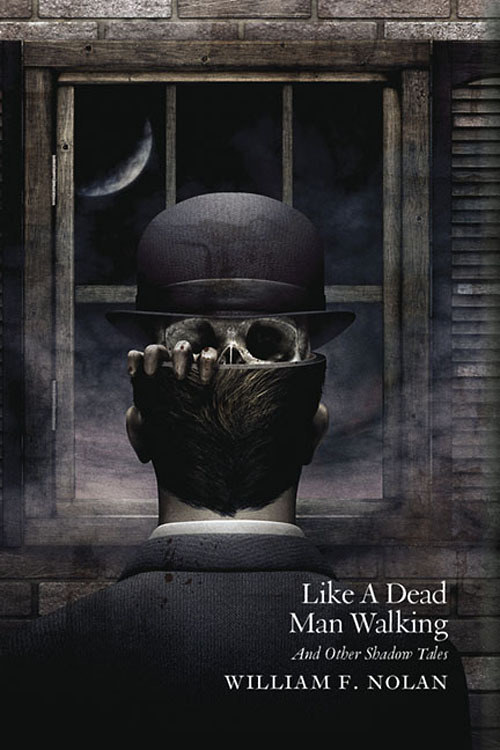
Like a Dead Man Walking, by William F. Nolan, Centipede Press, 2014. Cover art by David Ho, info and preview: centipedepress.com.
“Sherlock Holmes…Interdimensional demons…Aliens…Killers and child predators…Time travelers…Vampires…Even the end of the world, in more ways than one…All are contained within these pages. From the darkest corners of imagination to the precipice of human achievement, William F. Nolan delivers the goods in this assortment of recent works: his first all-new collection in his long and storied career. Working with editor Jason V Brock (Milton’s Children), Nolan brings to shocking life not only debauched murderers and depraved loners, but also fascinating portraits of personal reflection; the heroes of yore in poetry; pages from Nolan’s notebook; and an exclusive, intimate interview with his beloved friend, the late Richard Matheson (I Am Legend). Centipede Press is pleased and proud to offer this fantastic new assemblage of tales from an acknowledged master of the dark fantasy and science fiction genres, complete with insights into the stories, and a probing intrtoduction from editor Brock: This is not only Nolan’s most recent collection, but likely his very best. Come along for the ride and discover things that may (or may not) be Like a Dead Man Walking…You are sure to enjoy the journey. This signed limited edition is just 300 copies. The dustjacket is the work of David Ho. Each copy is signed by William F. Nolan, Jason V Brock, and David Ho.”
10:00 am |
Gennaio 26 2014
| 2 note
Nameless Digest Issue #3, edited by Jason V Brock & S.T….
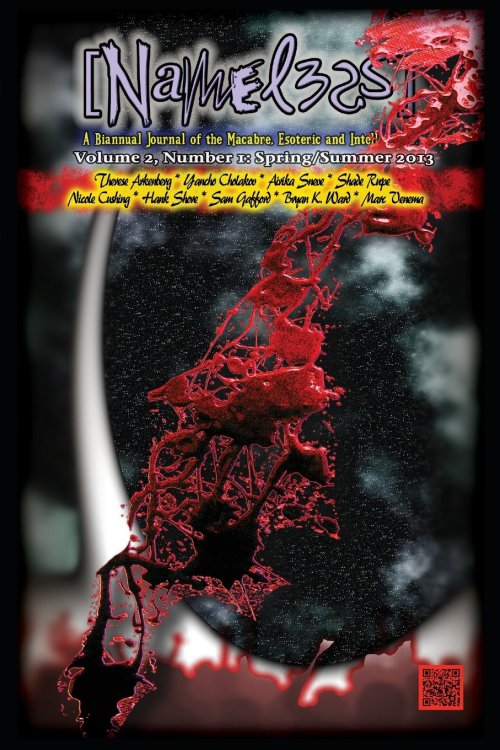
Nameless Digest Issue #3, edited by Jason V Brock & S.T. Joshi, Cycatrix Press, 2013. Info: jasunnistore.com.
“Nameless Digest is an exciting, outstanding biannual journal of the macabre and esoteric. It features articles, artwork, interviews, and fiction from some of the best in the fields of the Weird, science fiction, and horror, both classic and fresh voices, and all new. Nameless also presents outstanding reviews and scholarship of literature, cinema, and comics in a full-color, eye-catching format. The intended goal of Nameless is to meld divergent (even challenging) critical perspectives on a variety of subjects – fiction, music, art, film, social commentary – and present them with the best content (literary, artistic, and, in the case of the website, multimedia) we can muster. Nameless was conceived from the outset as a thought-provoking biannual print periodical, as well as a year-round online destination for the intellectually adventurous. We strive to achieve this via the alchemy of innovative discourse, high production values, and rigorous editorial standards. Though the focus will always be on the macabre, weird, uncanny and esoteric, Nameless will also be a bastion for the under-appreciated idea, the unexplored possibility, the poorly understood concept. We are not a home for the pedestrian, the obvious, the common. It is a state of mind as much as anything, and as such is accepting of anyone that is curious, thoughtful and rational.”
Contents:
Fiction & Poetry
Nicole Cushing – “The Mirrors”
Airika Sneve – “Abysmoira”
Nicole J. LeBoeuf – “Lambing Season”
K. M. Tonso – “Silver Hairs among the Gold”
Yancho Cholakov (Translated by Kalin M. Nenov) – “Asked the Soldier, “Who Called Me?”“
Mike Allen – “Monster”
Edward Morris – “The Part of Me They Could Not Kill Went On To Organize…”
David Agranoff – “The Classroom: A Vignette”
Therese Arkenberg – “The Witch Hunter’s Account”
JC Crumpton – Selected Poetry
Marc Venema – Selected Poetry
Ed Higgins – Selected Poetry
Kelda Crich – Selected Poetry
Nonfiction & Interviews
Hank Shore – Three Short Articles
Shade Rupe – Jean Rollin retrospective
Sam Gafford – The Man Who Saved (W. H.) Hodgson!
Jason V Brock – Bryan K. Ward (Interview)
Aaron J. French – Column
Artwork
Bryan K. Ward
Marc Bilgrey
Ron Sanders
Jason V Brock
Reviews by
Sunni K Brock
Stephanie M. Wytovich
Don Webb
8:00 am |
Marzo 16 2014


Dead Reckonings No. 14, edited by June M. Pulliam and Tony…
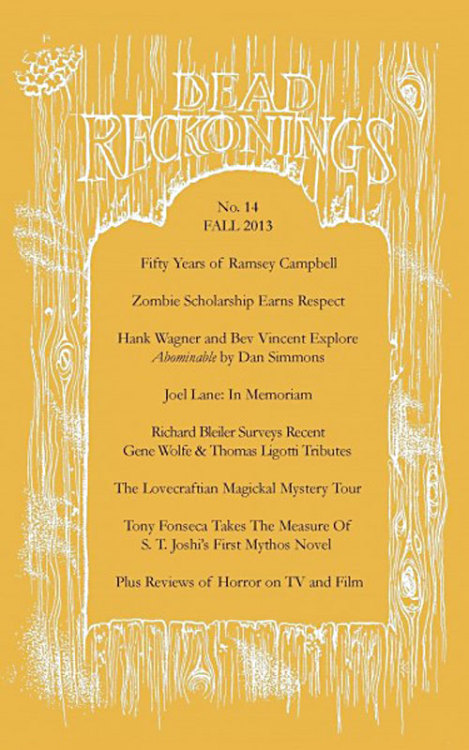
Dead Reckonings No. 14, edited by June M. Pulliam and Tony Fonseca, Hippocampus Press, 2014. Info: hippocampuspress.com.
“A Review of Horror Literature.”
Wagner and Vincent on Simmons – Hank Wagner and Bev Vincent (Dan Simmons, The Abominable)
Ramsey Campbell, Probably: The Grin Beneath the Flesh
From Horror to Homage – Richard Bleiler (J. E. Mooney and Bill Fawcett, eds., Shadows of the New Sun: Stories in Honor of Gene Wolfe; Joseph S. Pulver, Sr., ed. The Grimscribe’s Puppets)
Joel Lane: In Memoriam – Robert Butterfield
Other Realities—Alternate Readings: Two Views on Jason V Brock (Jason V Brock, Simulacrum and Other Possible Realities)
Outlier – Jonathan Johnson
Brock as Intriguing New Voice – Darrell Schweitzer
Malignant Mothers – Richard Bleiler (John Boyne, This House Is Haunted, Sophie Hannah, The Orphan Choir)
What Happens After – Sarah Simms (Ellen Datlow and Terri Windling, eds., After: Nineteen Stories of Apocalypse and Dystopia)
571 Forrester Lane Eats Babies – Matthew McEver (Sonja Condit, Starter House)
Triskaidekaphilia – Jonathan Johnson (Jonathan Thomas, Thirteen Conjurations)
Submitted: My Stamp of Approval – Tony Fonseca (Reba Wissner, A Dimension of Sound: The Music of The Twilight Zone)
Religious Fanaticism Run Amok – Antoinette Winstead (L. Andrew Cooper, Burning the Middle Ground)
Fifty Years of Ramsey Campbell – S. T. Joshi (Ramsey Campbell, Holes for Faces; The Kind Folk; and The Last Revelation of Gla’aki)
Two Veteran Storytellers Demonstrate How It Is Done – Robert Butterfield (Darrell Schweitzer, The Emperor of the Ancient Word; Tony Richards, The Universal and Other Terrors)
Zombie Scholarship Earns Respect – June Pulliam (Jennifer Rutherford, Zombies; Aalya Ahmad and Sean Moreland, eds. Fear and Learning: Essays on the Pedagogy of Horror)
Sequel Deserves to be a Forgotten Chapter – Braden Dauzat (James Wan, dir. Insidious: Chapter 2)
Haunted from Within and Without – Richard Bleiler (Ellen Datlow, ed. Hauntings)
A Darker Piece of Darkness – John Edgar Browning (Ellen Datlow, ed. The Best Horror of the Year, Volume 5 and Blood and Other Cravings; Laird Barron, The Beautiful Thing That Awaits Us All and Other Stories)
The Lovecraftian Magickal Mystery Tour – Leigh Blackmore (Peter Levenda, The Dark Lord: H. P. Lovecraft, Kenneth Grant and the Typhonian Tradition in Magic)
A Smorgasbord of Weird – S. T. Joshi (Lois H. Gresh, ed. Dark Fusions: Where Monsters Lurk!)
Portrait of the Mythos-Maker as a Young Man – Tony Fonseca (S. T. Joshi, The Assaults of Chaos: A Novel about H. P. Lovecraft)
Second Time’s the Charm – Leigh Blackmore (H. P. Lovecraft, The Ancient Track: The Complete Poetical Works)
Covens, Witchcraft, and Murder, Oh My! – Antoinette Winstead (Debbie Viguie, The Thirteenth Sacrifice: A Witch Hunt Novel)
Zombies Are People Too – June Pulliam (Jonny Campbell, dir., In the Flesh)
The Weird Scholar – S. T. Joshi
Notes on Contributors
8:00 am |
Febbraio 15 2014
| 1 nota

The Best of The Horror Society 2013, edited by Carson…
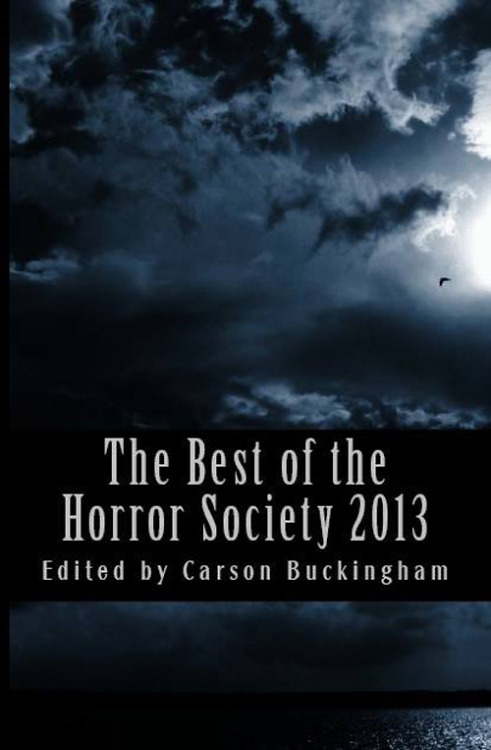
The Best of The Horror Society 2013, edited by Carson Buckingham, The Horror Society/CreateSpace Independent Publishing Platform, 2013. Info: createspace.com.
“A central coast trip that leads to devastating consequences for wine collectors. An adjoining hotel room that isn’t what it seems. A long bus trip with a stopover in an eerie little town. You’ll visit these places and more in this volume. Or how about the old woman with the strange plant? Or the odd little boy selling lemonade? Perhaps the sideshow lady who just smells so good? You’ll meet them all at the turn of a page and they will remain with you long after the book is closed. The Best of the Horror Society 2013 is an anthology of the weird, the wonderful, and the downright wicked. Within you will discover not only the best of emerging horror writers but seasoned pros whose names you will no doubt recognize as well. So turn out the lights, pull up a chair beside the nearest roaring fireplace and enjoy the ride.”
Contents:
FOREWORD – Scott M. Goriscak
INTRODUCTION – Carson Buckingham
CEREMONY – William F. Nolan
TENDRILS NEVER LIE – Kevin A. Ranson
THE MASK – Lisamarie Lamb
LEMMINAID – Carson Buckingham
THE CENTRAL COAST – Jason V. Brock
WHITE HELL, WISCONSIN – Weldon Burge
VICTIMIZED – Richard Thomas
NORMAL IS RELATIVE – Dan Dillard
THE PROCEDURE – Doug Lamoreux
THE LITTLE CHURCH OF SAFE CROSSING – Joe McKinney
MADELEINE – Julianne Snow
IT HAS TEETH – Christian A. Larsen
MASQUERADE – Dave Jeffery
BLACK BIRD – Rose Blackthorn
ADJOINING ROOMS – Scott M. Goriscak
THE INSPIRATION & HORROR OF GEORGE & HUGH – Nicholas Grabowsky
THE CLOWN – Henry Snider
MOVING DAY – Mark Onspaugh
ELLEN – Lee Pletzers
DADDY – Aaron Warwick Dries
SOFT LIKE HER – Charles Colyott
VENUS – L.L. Soares
THE LUMINOUS VEIL – Ian Rogers
BEER & WORMS – T.E. Grau
BLACK MARY – Mercedes M. Yardley
THE BOY IN THE ELEVATOR – Robert S. Wilson
WEIRD – Dean M. Drinkel
HOTTIES – Mort Castle
10:00 am |
Novembre 17 2013
| 1 nota