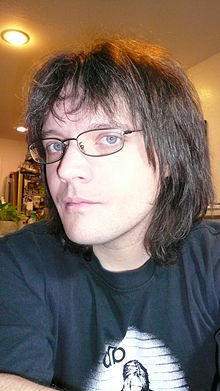
Jason V Brock

Thumbnail

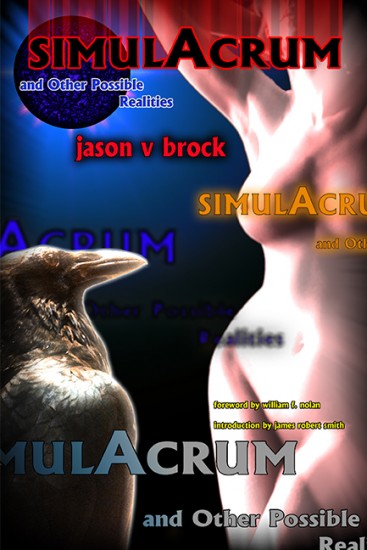
19 Jul: Fiction Tips Weekly: SimulAcrum: A new collection by Jason V. Brock

In a very rudimentary sense
simulacrum, derived from Latin, means likeness or similarity, a representation
or image. One thinks of the mirror image of one’s self it is true in form
however reversed but lacks the actual substance of the original that casts the
reflection, i.e. the human form standing before the mirror. What is dark
fiction, horror, but visceral writings of the gut that inevitably represent the
deeper truth of what and who we are and what our nature is truly about. These
genres reveal through a vial all that human kind represses, true to form, but
lacking enough to be a story, and dream, or a nightmare.

Jason V Brock (without the
period) is a visceral writer. As we can see from this delightful anthology of
his works, he can rip to the gut and have you attempting
desperately to stuff your entrails back inside before it’s too late.

In the forward written by the
legendary William F. Nolan, the writer remarks “He (Jason) is a deep thinking
individual, even a provocateur, and his work is sometimes extreme, dark and
gruesome…he uses it to expose some flaw or weakness in a character.”

My own experience with Jason
and his writing tells me that there will always be those that exclaim the man
is too controversial. The problem with those views is that it is all too
revealing of the gainsayers that are most likely thick with denial. People,
critical examiners really, that just don’t want to hear the truth. The fact is,
if they don’t want to hear about their own unlovely nature, then they really
need to get out of the horror industry all together because they are doing no
justice there. If there is one thing that Jason’s stories tell us about, it’s
about our lives, our nature, our truth, our self. And through a representation
of that visceral truth, we can see clear to original that lies beyond in the
land of reality.

The collection kicks off with
“What the Dead Eyes Behold.” An image of
that very moment when you look into your significant other’s eyes and are
overwhelmed with the very deepest feelings of love so much that you want to
preserve the moment forever, and ever… and ever!

Next up “The Central Coast,” a
story previously published in Dark Discoveries magazine, starts us off in the
middle trauma and shock. Social gatherings can be horrific enough, without even
coming close to this event. Brock displays the same expertise in setting up the
reader in this story as any Stephen King has written. He enthralls the reader
with terribly vivid scene irresistible to our curious nature only to bring that
shocking and terrible discovery you’d wished you’d never come upon. One thing
is for sure, if you are a wine connoisseur, you might think twice about that
rare estate reserve you’ve had eyes on. It may be more expensive than you
think.

It’s impossible to describe in
a review the depth experienced in reading anything Brock has penned.
Descriptions are as the title suggests only a representation of the actual
experience of reading his work. There are many stories in this collection,
fifteen plus his new novella “Milton’s Children,” but I find it irresistible
not to spoil some delight in each of them. Therefore I’ll leave the rest for
your own experience, an experience that comes highly regarded and suggested.

— Review by Cyrus Wraith Walker

18 Jul: Collings Notes: Jason V. Brock’s “Milton’s Children”–Paradise …

Jason
V. Brock. “Milton’s Children.” Bad Moon Books, 2012.

I
don’t know whether Jason Brock wears a hat or not. But if he does, he must have
been kept busy tipping it while writing his singularly effective novella,
“Milton’s Children.”

The
story begins, perhaps a bit oddly, with a question: “Why are you a vegetarian,
Carter?” This relatively non-horrific question introduces both a primary
character, Adam Carter (the name is highly suggestive, given the novella’s
title and the headnote from John Milton’s Paradise
Lost
), and a key issue…although for several pages the ensuing dialogue
between Carter and his equally suggestively named antagonist, Chris Faust (c.f. Christopher Marlowe, Dr. Faustus, another Renaissance
disquisition on pride, sin, forgiveness, and hell) seems more a one-sided rant
than the introduction to a short story.

The
two characters cover a number of issues, although Faust is more often than not limited
to a few words or sputtered phrases while Carter is given full play for his
arguments, which include the possibility of animal communication before
broadening to incorporate pollution, global warming, overuse of antibiotics and
chemicals, and a range of additional appalling side-effects of human arrogance.
Finally, Carter asks his own question, “I mean, where does ‘evil’ begin to
enter into the picture, Faust?”

After
a brief hiatus for some necessary backstory, the tale reaches a transition
point and moderates into what is essentially a finely crafted throwback to the
Golden Age of Creature Features. One of the crew has discovered a mysterious, unknown
island, revealed only when global warming causes the Antarctic floes to recede.
Perhaps never trodden on by humans, the island offers a temptation none can
resist. They must explore it.

The first
impression the landing crew receives is of an Antarctic Garden of Eden…but as
with all great Creature Features, first impressions prove woefully,
disastrously, horrifically and bloodily wrong.

And thus
the deaths begin.

In
addition to those already mentioned, Brock incorporates layer upon layer of
allusion to strengthen his modest tale. Several are referred to by name: Jonathan
Swift and A Modest Proposal; Mary Shelley
and Frankenstein (with its insistence
on Paradise Lost as a proof text for
the creature’s moral inquiries); H.P. Lovecraft and At the Mountains of Madness; Skull Island and the various film
versions of King Kong. Others seem
more incidental, although still powerful: E.R. Burroughs’ Pellucidar series
(one of Brock’s characters is Darrell Mahar). The captain of the rescue ship in
the final chapters is Commander Merritt (c.f. A. Merritt?) and the Communications
Officer is surnamed ‘Adams,’ underscoring at least two major themes in “Milton’s
Children.”

(And
one intriguing echo—which I can’t lay this on Brock, of course, since I don’t
know what films he has watched—by the end of his story there are a number of key
resemblances in “Milton’s Children” to one of my favorite ’50s pieces, Roger
Corman’s The Attack of the Crab Monsters.)

Tying
all of these disparate threads together is the introductory note, Satan’s
speech as he surveys the newly created Earth (Paradise Lost, Book IX, ll. 135-139) and brags of the destruction
is he about to wreak on it and on unsuspecting humanity. Although it is clear from
the poem as a whole that Satan is here being self-delusive and that the Father
has in fact planned all that occurs, his words remain powerful. Like others
alluded to in “Milton’s Children”—Milton’s Adam, Marlowe’s Faust, Frankenstein,
Lovecraft’s multifold meddlers in Cosmic affairs, generations of fictional explorers invading unknown
landscapes where they have no right to be—Satan is about to assert dominion over
that which is not his…and pay the ultimate consequences.

In
total, “Milton’s Children” is fascinating. It blends elements that seem on the
surface antithetical. It encourages reminiscence even as it suggests
far-reaching, futuristic possibilities. It combines an elegant command of
language with a relatively fundamental but thoroughly enjoyable plot. It
incorporates clichéd characters and situations in ways that bring them new
life. It manages to tip its hat to perhaps a score of equally intriguing sources while maintaining its own integrity as a narrative. And all within the confines of fewer than seventy pages.

Recommended.

Thumbnail

18 Jul: Guest Appearance–Stephanie M. Wytovich

image

Good Wednesday,

The Lockbox is happy to have a guest today. You may remember Stephanie Wytovich. I interviewed her last summer. Well, she’s back, and she’s going to talk about her forthcoming book of horror poetry, HYSTERIA.

Without further ado, here she is.

-So…talk to us about HYSTERIA. What’s it about?

The easy answer is that HYSTERIA is about madness, but to me, it’s always been about acceptance. When I sat down and decided to start writing it, I essentially decided to go a little mad myself. There was nothing easy about writing this collection: no fun nights composing next to the moon, no clever evenings spent making up metaphors and bringing characters to life.

It was hard.

And it was painful.

I read a lot of abnormal psychology, studied the diseases of the brain, and traveled across the states to visit different asylums and feel the air and the charge of what it meant to be locked up in solitary. I sat in the isolation rooms of West Virginia’s State Penitentiary, and spent the night at the Trans-Allegheny Lunatic Asylum.

And then I met her.

Hysteria.

Most of the pieces came to me late at night, crazed and racked by insomnia, and when they did, they were fluent and clear, as if I were talking to the characters one-on-one. I wrote down their voices, shaped the faces that I saw in my nightmares, and looking back, it’s no wonder I didn’t sleep. The patients that readers will meet in this collection are vicious, cruel, and more often than not, completely insane.

Although there are a few innocents.

But who out there is really walking around with a clean conscience?

-What inspired you to put the book together?

When I was an undergraduate at Seton Hill University, I had to start a blog for my Intro. To Literary Study course. I heard everyone talking about blogs and their importance, but to me, it just seemed like another chore that I had to maintain when all I wanted to do was write poetry and study art. But, I created one…quite sarcastically at that.

“Join me in the madhouse,” I said.

Blogging drove me insane, and I hated doing it. And then one day, I hated it a little less, and then even lesser than that. The crazy part about it was that I soon started doing it for fun. I played with the madhouse theme, reviewing psychological films and critiquing books under the veil of psychoanalytic criticism. I read a lot of Freud—probably too much Freud—and paid special attention to his ideas on sexuality and the uncanny.

I saw madness—erotic, uncanny madness—everywhere I went.
The thick, black sludge of the mind’s breaking point.

And when I realized that madness broods inside us all—whether we choose to accept it or not—I knew that I had to explore it, dissect it, rip it apart with a scalpel and study it.

And so I did.

-Is there anything in there that shocked even you?

The entire collection was/is quite shocking to me. Yes, I realize that probably sounds odd considering I write horror, but I don’t think I’ve ever created something so dark, so angry before. There are pieces in there that I look at and think who/what wrote that?

But that’s what I wanted.

I wanted the voice that not only sits in the shadows, but is the shadows. I wanted darkness, blackness, and madness all wrapped up in a straightjacket and ready to go.

And then I wanted to release it and watch the asylum burn.

-Do you ever see yourself writing anything but horror?

Horror is what I do—what I love to do—and I can’t imagine doing anything else, because let’s face it… horror is in everything. What’s scarier than exploring space and meeting aliens? What’s more frightening than meeting creatures that exist only in your wildest dreams? And what’s more horrifying than falling in love?

Fear is in everything.

It doesn’t matter what genre I’m writing in.

I’m going to strangle it and take it down.

-Name a book/tv show/movie you like that would surprise people.

Something that would surprise people, eh?

I’ve seen every episode of Spongebob to date.

And I was there opening day to see the movie when it came out.

That crazy, yellow sponge cracks me up.

Preorder your copy of HYSTERIA here.

Find Stephanie on the web at her blog. Follow her on Twitter @JustAfterSunset.

She’s also on Goodreads. Enter the giveaway to win a free copy of HYSTERIA!

“Also, I’ll be reading from Hysteria at Kafe Kerouac on August 2 from 7-9 p.m. alongside fellow poets John Edward Lawson and Michael A. Arnzen to kick off DogCon2. There will be comedy, madness, and amputated prose, not to mention a whiskey tasting to follow! We’d love to see you there!”

About Stephanie
Stephanie M. Wytovich is an Alum of Seton Hill University where she was a double major in English Literature and Art History. Wytovich is published in over 40 literary magazines and HYSTERIA is her first collection. She is currently attending graduate school to pursue her MFA in Writing Popular Fiction, and is working on a novel. She is the Poetry Editor for Raw Dog Screaming Press and a book reviewer for S.T. Joshi, Jason V. Brock and William F. Nolan’s Nameless Magazine. She plans to continue in academia to get her doctorate in Gothic Literature.

Check out my previous interview of Stephanie here.