Sunni

31 Jul: DVD Review: LIFE AFTER DEATH PROJECT (2013)

Paul Davids, the director of the documentary The Sci-Fi Boys spurred this exploration of the afterlife after an odd encounter in a hotel room. While staying at a hote he printed a piece of paper, he then left the room for a few moments and when he returned he found what he believes was proof that his friend, the departed Forrest J Ackerman of Famous Monsters of Filmland magazine, had reached out him from beyond the grave. Actually, what he found was an unexplained ink smudge on a piece of paper, but this documentary would have you believe it’s proof of the existence of the conscious mind from beyond.

Personally I do believe in something in the hereafter. What exactly that is I won’t speculate on but I do hope there’s something beyond what we know, I wanna believe there’s more than just rotting in the dirt. When my younger tragically brother passed on at a young age I found myself speaking to him while I was alone in the dark, I was full of regret and mourning his death, there were so many things I wished I’d said, and I would find myself speaking these things to him as if he were there. Do I think he was present at the time, was his spirit with me, does anyone really know?

Paul Davids and a small group of true believers, scientists and friends of the departed Forrest J Ackerman would have you believe yes, there’s something out there. we have entries from respected science fiction authors Richard Matheson, Whitley Strieber, Dannion Brinkley and Michael Shermer, whom all chime in. There are also testimonies and research from scientist including Gary Schwartz, the Director of the Laboratory for Advances in Consciousness and Health, here in Tucson, AZ at The University of Arizona, where I work. Schwartz in his lab attempts to communicate with the deceased through a series of yes/no questions and awaits a metered response, which proves absolutely nothing in my opinion. Seriously, until I see an apparition myself it’s gonna be difficult for me to believe, not that I do not want to, I just need a little proof.

Some of these testimonies are compelling stories, witnesses recount weird happenings that they assign to the afterlife, but c’mon now, papers falling off a chair… one time! If it weren’t for the trappings of Forry Ackerman here I don’t think I would have even given this documentary a shot, I hate shows like Ghost Hunters. I do appreciate the fond remembrances of the the world’s ultimate science-fiction nerd but as a science-based exploration of life after death the film is utterly lacking, simply stating that science cannot rule out communication from the afterlife does not prove squat.

There are 40 minutes of bonus features including audio excerpts from a 2009 tribute to Ackerman with touching tributes from Rick Baker and Ray Bradbury. There’s also a second disc featuring The Life After Death Project 2 – Personal Encounters (101 Mins) with further testimony about personal accounts of supposed life after death. I would much rather watch a documentary about Forrest J. Ackerman’s life and what he meant to legions of fans, what happened after his death is of far less interest. 2 Outta 5

Thumbnail

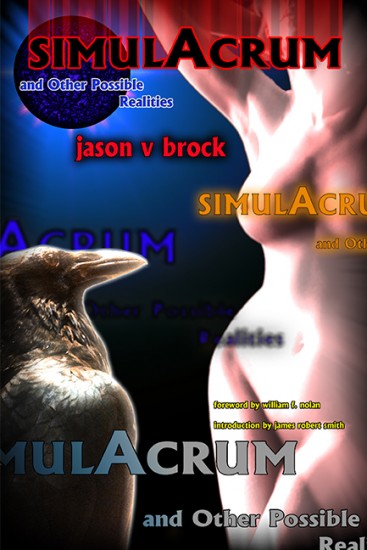
19 Jul: Fiction Tips Weekly: SimulAcrum: A new collection by Jason V. Brock

In a very rudimentary sense
simulacrum, derived from Latin, means likeness or similarity, a representation
or image. One thinks of the mirror image of one’s self it is true in form
however reversed but lacks the actual substance of the original that casts the
reflection, i.e. the human form standing before the mirror. What is dark
fiction, horror, but visceral writings of the gut that inevitably represent the
deeper truth of what and who we are and what our nature is truly about. These
genres reveal through a vial all that human kind represses, true to form, but
lacking enough to be a story, and dream, or a nightmare.

Jason V Brock (without the
period) is a visceral writer. As we can see from this delightful anthology of
his works, he can rip to the gut and have you attempting
desperately to stuff your entrails back inside before it’s too late.

In the forward written by the
legendary William F. Nolan, the writer remarks “He (Jason) is a deep thinking
individual, even a provocateur, and his work is sometimes extreme, dark and
gruesome
he uses it to expose some flaw or weakness in a character.”

My own experience with Jason
and his writing tells me that there will always be those that exclaim the man
is too controversial. The problem with those views is that it is all too
revealing of the gainsayers that are most likely thick with denial. People,
critical examiners really, that just don’t want to hear the truth. The fact is,
if they don’t want to hear about their own unlovely nature, then they really
need to get out of the horror industry all together because they are doing no
justice there. If there is one thing that Jason’s stories tell us about, it’s
about our lives, our nature, our truth, our self. And through a representation
of that visceral truth, we can see clear to original that lies beyond in the
land of reality.

The collection kicks off with
“What the Dead Eyes Behold.” An image of
that very moment when you look into your significant other’s eyes and are
overwhelmed with the very deepest feelings of love so much that you want to
preserve the moment forever, and ever
 and ever!

Next up “The Central Coast,” a
story previously published in Dark Discoveries magazine, starts us off in the
middle trauma and shock. Social gatherings can be horrific enough, without even
coming close to this event. Brock displays the same expertise in setting up the
reader in this story as any Stephen King has written. He enthralls the reader
with terribly vivid scene irresistible to our curious nature only to bring that
shocking and terrible discovery you’d wished you’d never come upon. One thing
is for sure, if you are a wine connoisseur, you might think twice about that
rare estate reserve you’ve had eyes on. It may be more expensive than you
think.

It’s impossible to describe in
a review the depth experienced in reading anything Brock has penned.
Descriptions are as the title suggests only a representation of the actual
experience of reading his work. There are many stories in this collection,
fifteen plus his new novella “Milton’s Children,” but I find it irresistible
not to spoil some delight in each of them. Therefore I’ll leave the rest for
your own experience, an experience that comes highly regarded and suggested.

— Review by Cyrus Wraith Walker

18 Jul: Collings Notes: Jason V. Brock’s “Milton’s Children”–Paradise …

Jason
V. Brock. “Milton’s Children.” Bad Moon Books, 2012.

I
don’t know whether Jason Brock wears a hat or not. But if he does, he must have
been kept busy tipping it while writing his singularly effective novella,
“Milton’s Children.”

The
story begins, perhaps a bit oddly, with a question: “Why are you a vegetarian,
Carter?” This relatively non-horrific question introduces both a primary
character, Adam Carter (the name is highly suggestive, given the novella’s
title and the headnote from John Milton’s Paradise
Lost
), and a key issue
although for several pages the ensuing dialogue
between Carter and his equally suggestively named antagonist, Chris Faust (c.f. Christopher Marlowe, Dr. Faustus, another Renaissance
disquisition on pride, sin, forgiveness, and hell) seems more a one-sided rant
than the introduction to a short story.

The
two characters cover a number of issues, although Faust is more often than not limited
to a few words or sputtered phrases while Carter is given full play for his
arguments, which include the possibility of animal communication before
broadening to incorporate pollution, global warming, overuse of antibiotics and
chemicals, and a range of additional appalling side-effects of human arrogance.
Finally, Carter asks his own question, “I mean, where does ‘evil’ begin to
enter into the picture, Faust?”

After
a brief hiatus for some necessary backstory, the tale reaches a transition
point and moderates into what is essentially a finely crafted throwback to the
Golden Age of Creature Features. One of the crew has discovered a mysterious, unknown
island, revealed only when global warming causes the Antarctic floes to recede.
Perhaps never trodden on by humans, the island offers a temptation none can
resist. They must explore it.

The first
impression the landing crew receives is of an Antarctic Garden of Eden
but as
with all great Creature Features, first impressions prove woefully,
disastrously, horrifically and bloodily wrong.

And thus
the deaths begin.

In
addition to those already mentioned, Brock incorporates layer upon layer of
allusion to strengthen his modest tale. Several are referred to by name: Jonathan
Swift and A Modest Proposal; Mary Shelley
and Frankenstein (with its insistence
on Paradise Lost as a proof text for
the creature’s moral inquiries); H.P. Lovecraft and At the Mountains of Madness; Skull Island and the various film
versions of King Kong. Others seem
more incidental, although still powerful: E.R. Burroughs’ Pellucidar series
(one of Brock’s characters is Darrell Mahar). The captain of the rescue ship in
the final chapters is Commander Merritt (c.f. A. Merritt?) and the Communications
Officer is surnamed ‘Adams,’ underscoring at least two major themes in “Milton’s
Children.”

(And
one intriguing echo—which I can’t lay this on Brock, of course, since I don’t
know what films he has watched—by the end of his story there are a number of key
resemblances in “Milton’s Children” to one of my favorite ’50s pieces, Roger
Corman’s The Attack of the Crab Monsters.)

Tying
all of these disparate threads together is the introductory note, Satan’s
speech as he surveys the newly created Earth (Paradise Lost, Book IX, ll. 135-139) and brags of the destruction
is he about to wreak on it and on unsuspecting humanity. Although it is clear from
the poem as a whole that Satan is here being self-delusive and that the Father
has in fact planned all that occurs, his words remain powerful. Like others
alluded to in “Milton’s Children”—Milton’s Adam, Marlowe’s Faust, Frankenstein,
Lovecraft’s multifold meddlers in Cosmic affairs, generations of fictional explorers invading unknown
landscapes where they have no right to be—Satan is about to assert dominion over
that which is not his
and pay the ultimate consequences.

In
total, “Milton’s Children” is fascinating. It blends elements that seem on the
surface antithetical. It encourages reminiscence even as it suggests
far-reaching, futuristic possibilities. It combines an elegant command of
language with a relatively fundamental but thoroughly enjoyable plot. It
incorporates clichéd characters and situations in ways that bring them new
life. It manages to tip its hat to perhaps a score of equally intriguing sources while maintaining its own integrity as a narrative. And all within the confines of fewer than seventy pages.

Recommended.